For My Country: A Resistance Soldier Shares Her Story of Heartbreak and Hope

When the Burma Army violently overthrew the democratic government of Burma on Feb. 1, 2021, many families in central Burma were forced to decide between supporting the violent regime or taking a bold, and dangerous, stand against it - either by participating in the Civil Disobedience Movement (CDM) or joining up with an armed resistance group. This was the difficult decision presented to Ma Nann and her husband, Phone Zaw Win, when the military took control of their community.
Before the coup, the married couple raised their two children in relative peace, living and working in the Bago region, not far from Yangon. Ma Nann helped her husband with their farming business and worked as a makeup artist, a job that she loved. The couple were high school sweethearts and were married six years when, early in the morning on Feb. 1, 2021, the lights in their home shut off. The next day, they lost cell service and found themselves in a nationwide internet blackout. Like many other families in the region at the time, their initial reaction was to wait. They had heard about the power grab in central Burma and decided to hunker down in their home for a week, hoping that the complications caused by the coup would blow over. Unfortunately, things became increasingly worse across the region, and the couple decided to act.

As the political situation continued to deteriorate, Ma Nann began helping orchestrate and lead various marches in villages across the Bago region. The CDM movement was growing in popularity. Ma Nann and Phone Zaw Win balanced parenting two young children, their youngest only months old, with their stand against the corrupt government. It only took one month of advocacy for Ma Nann to be identified by local Burma Army soldiers and police as a threat to their regime.
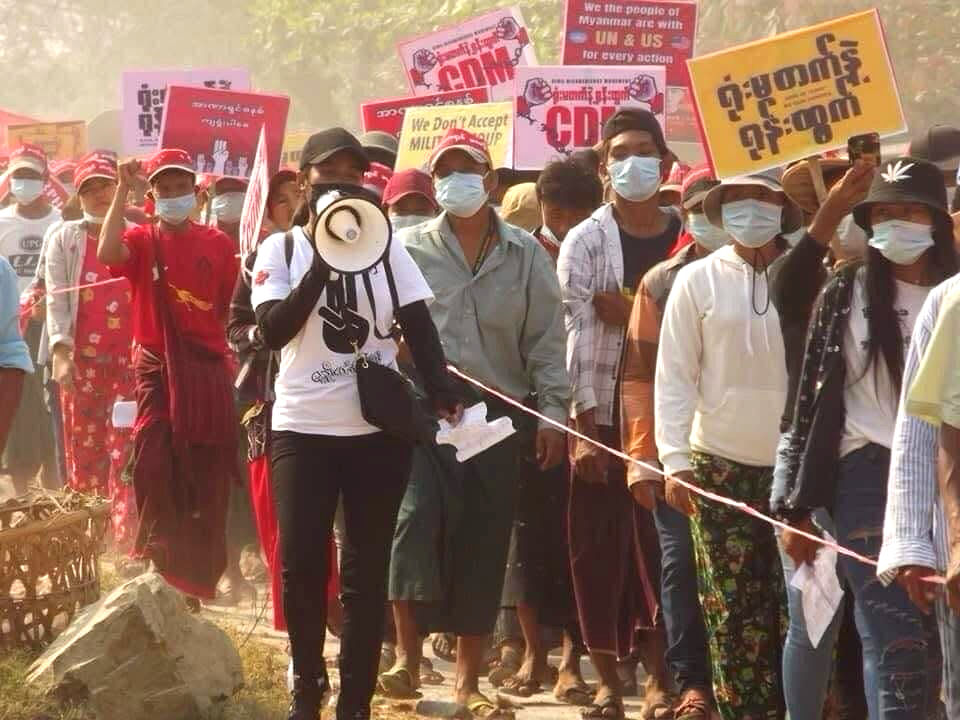
The couple had heard about the violent crackdowns against protesters. “We knew the risks, and yet I kept going for my country,” Ma Nann said. One morning, as Ma Nann was driving home on her motorbike, she passed by a police station, from which several police officers began firing rounds near the street. The fear of being hit by rounds her to crash, but she was uninjured and able to sprint away from the mangled bike and the police. The officers gave chase, and she escaped by hiding in an abandoned house nearby. From there, Ma Nann called Phone Zaw Win, who stealthily rescued her from the house that evening under the cover of darkness. Though she was unharmed in the confrontation, she felt rattled by the regime's show of force.

The day after the police officers shot at the young mother, Ma Nann heard that the Burma Army issued a “shoot on sight” order for her, due to Ma Nann's popularity as a protest leader. The next day, Burma Army soldiers were at her door, demanding that she turn herself in. Her mother-in-law and husband kept the soldiers at bay, convincing them that she was away, while Ma Nann hid on the roof. The stalemate lasted for hours until the soldiers finally left. Despite the threats of arrest and death, both husband and wife continued to protest peacefully, hoping that non-violent advocacy would return human rights to the region.

Things were getting worse. After three full and terrifying months of valiant protesting, the CDM group in the area was dwindling. People were being arrested and killed, and refuge from the Burma military at home was no longer feasible. Ma Nann and Phone Zaw Win began considering their options. “We decided enough was enough,” Ma Nann said. The couple decided to take up arms against their government to achieve peace in their community. Phone Zaw Win’s mother agreed to care for their children, and the couple traveled east into Karen State to be trained at a Karen National Union (KNU) camp. They were transferred to a People's Defense Force (PDF) camp, where they were trained and equipped to serve as soldiers. Ma Nann explained that she faced challenges as the only woman in her unit. “They were hesitant to have a mother of two young children fight with them. But I insisted, and I worked hard,” she said.
In early Feb. 2024, Ma Nann and Phone Zaw Win were preparing for a battle near their hometown in Bago. The PDF unit was spread across the line, and the couple became separated, each a member of a different offensive flank. The attack against Burma Army territory was supposed to begin at midnight, but the attack was pushed back four times. Ma Nann called her husband to update him on when to finally engage, and their conversation was brief but intentional. She recounts: "He said ‘just be careful and take care of yourself’, and I will never forget those words.”

It was a dark, early morning, with thick fog that limited visibility. The sounds of artillery dominated the dawn for hours after the battle had started. During the fighting, Ma Nann heard the report that multiple PDF soldiers had been injured at the front, and when the battle had settled down, she hurried to the Casualty Collection Point (CCP) to check on the wounded. She did not know that Phone Zaw Win was among the casualties, and when she saw his still face among the others, she immediately fell to the ground beside him. He had been struck in the chest by shrapnel from Burma Army artillery and was unresponsive. She held him, begging him to wake up, but he was dead. She was unwilling to accept it. She found a truck to transport her husband to a nearby clinic, but the driver did not want to waste a trip on a body. She gathered blankets and carried him to the clinic herself. When the medics there confirmed his death, Ma Nann was overcome by grief. “It was the worst nightmare for me.”

Before Phone Zaw Win was killed, the married couple had sat together at a PDF camp and discussed what they would do if one of them died in the conflict. They agreed that they would continue fighting regardless of what happened to the other. In the weeks after the death of her husband, Ma Nann felt that she must prioritize serving her country over returning to her family, citing the civil duty rhetoric of Aung San Suu Kyi as her primary inspiration. She saw the continued suffering of civilians across her home and decided to remain with the PDF in Karen State, where she has served to this day, collaborating with Rangers and resistance militias to provide safety for civilians among war-torn communities. When asked about her motivation to remain a member of the armed resistance, this was her response: “I don’t want to fight. I fight because there is no choice.”

2022 Free Burma Rangers CDM Leadership Training.
We met Ma Nann and Phone Zaw Win in 2022, when they attended an FBR-led training in Karen State, where the Ranger curriculum equipped them with tools for their leadership roles. After the coup, a new demographic of young people with a desire to serve their communities arose from central Burma, similar to Ma Nann's story. FBR saw this need and began leading condensed training courses, focused on teaching humanitarian skills to those already advocating within the CDM. "I learned about leadership, management, and emergency life-saving medical skills." In addition to the difficult and rewarding training, Ma Nann recalls the model of love portrayed by Rangers. "Importantly, I was taught by example about love and compassion. Before attending this training, I was already a PDF soldier. We fought against the Myanmar military with hatred. However, after completing the training, we were able to fight this battle with love in our hearts, even love toward our enemies."
She said that being around people who put others first inspires her. After the death of her husband, Ma Nann took great comfort in the company and encouragement of Rangers, many of whom she had known since her training with FBR. "I had a difficult time grieving my husband, but being around Rangers helps me be vulnerable and process." She recently attended a Ranger meeting where she reconnected with dear friends and offered us a chance to tell her story. “I also love the FBR motto; it is a good reminder, so I get it tattooed. My husband loved tattoos."

Ma Nann, now 38, has been resisting the Burma Army for five years; most of that time separated from her remaining family. She fears for the lives of her loved ones and hopes for an opportunity to see them soon. Her children, now ages 5 and 10, have not seen their mother in over a year. Burma Army soldiers arrested multiple members of her family since she joined the resistance, including her nephew, who was held in prison by the regime for three years. She asks for prayer on behalf of her community, her family, and finally for the release of Aung San Suu Kyi, the 80-year-old leader of the Bamar democratic movement, who has been unjustly held by the Burma Army since the 2021 coup.

The violence by the Burma Army against civilians in central Burma continues to this day, causing tens of thousands of young people to join up with various resistance groups. Ma Nann exemplifies the courage and steadfastness of a freedom fighter and has endured the Burma military's direct fire, drones, and airstrikes while in the service of displaced people. Please pray for this mother as she fights for the people of Burma, that she would continue to be a blessing to others, and that Ma Nann would be able to return to her family safely.
Thanks and God bless,
The Free Burma Rangers.